The dust has settled on this year’s climate negotiations. The Conference of the Parties to the UN Framework Convention on Climate Change (COP30) took place in Belém, Brazil in November. The location was symbolically important for climate, nature, and indigenous communities. And, for the first time, the world said in unison: ‘the global transition to low greenhouse gas emissions and climate-resilience is irreversible and the trend of the future’.
This article takes a look at the key outcomes from COP30, both inside the negotiations within the formal negotiated text, and outside the negotiations, as well as a look at the path forward.
COP’s 30th birthday
COP30 marks the 30th year of global cooperation between 194 countries on climate change. This is quite a remarkable feat.
And whilst many have suggested that COP30’s formal negotiated outcomes are disappointing, it is all too easy to take for granted the progress that has been made towards limiting the worst impacts of climate change.
Without COPs, here is what the world might look like:
- Global climate science would be weaker. COP has given climate science a global role, and helped create the systems, funding, and political demand that allowed climate science to flourish.
- Emissions accounting inventories as we know them now would not exist. COP mandated legal reporting requirements and improved transparency around emissions across the world.
- The energy transition would be far slower. Fossil fuels would dominate for longer, and there would be far less investment in renewables.
- Global temperatures would be significantly higher than they are now, with the world likely on track for 4-4.5°C warming by 2100, almost double the warming currently predicted.

Key outcomes from the negotiations
Adaptation and resilience
A major outcome of COP30 was the agreement to triple global funding for climate adaptation by 2035. This would direct around $120 billion towards adapting and strengthening resilience to climate change impacts.
Negotiators also adopted a set of indicators to track how well countries are adapting to climate change, called the Global Goal on Adaptation (GGA). The framework includes 59 indicators across seven sectors, including water, agriculture and health, and the adaptation policy planning process, as well as measures covering finance, capacity building and technology transfer.
Just transition
COP30 delivered an agreement to create a ‘Just Transition Mechanism’. Its purpose is to help countries manage the shift from fossil fuel-based economies in ways that support workers, protect communities, Indigenous peoples, and vulnerable groups. This includes job protection; retraining; social safety nets; support for communities historically dependent on fossil fuels or high-carbon industries; and the inclusion of social justice in climate action. The mechanism is meant to work alongside mitigation and adaptation efforts and broaden the economic benefits of clean energy.
Though this is a major win, operationalising the mechanism amid shrinking budgets, both for the UNFCCC and climate action more broadly, still poses significant challenges.
Trade and finance
For the first time, global trade became a core theme of the talks, with recognition that trade policies are closely interlinked with climate action. The negotiated text (called the Mutirão) included a three-year work programme on unilateral climate-related trade measures. This was borne out of significant pushback by developing countries on the EU’s Carbon Border Adjustment Mechanism, which has been seen as harmful to economic development.
Gender Action Plan
The Belém talks concluded the negotiations on the Gender Action Plan, which aims to support the integration of gender into national climate policies and plans. It covers women with disabilities, Indigenous women, women in rural and remote communities, and women and girls of African descent. The recognition that multidimensional factors, such as race, disability, and age, shape people’s experiences with climate change and their ability to engage in climate action is an important step forward.
No mention of transitioning away from fossil fuels
The final text does not include a binding or explicit commitment to phase out fossil fuels, which has been seen by many as a failure. This is because the COP makes decisions by consensus, and there was no prospect of consensus being reached on a fossil fuel roadmap. More than 80 countries showed support, but there were some petrostates who blocked and obstructed the wording from being included. However, it is worth noting that the first time language on a “transition away from fossil fuels” was included was only 2 years ago, at COP28 in Dubai.
Draft language on fossil fuel subsidy reform did not make it into the Mutirão decision either.
Outcomes from outside of the negotiations
Fossil fuel roadmap
Although the fossil fuel phaseout language did not make it into the final text, a group of countries came together to form a roadmap away from fossil fuels outside of the formal UN process. So far, the coalition includes 24 nations, including the Netherlands, UK, Germany, Colombia, Kenya and vulnerable Pacific Island states.
The First International Conference on the Just Transition Away from Fossil Fuels will take place in April 2026, in the port city of Santa Marta, Colombia, which plays a significant role in coal exports. Colombia and the Netherlands will co-host the event. It is hoped that the ‘coalition of the willing’ may be able to make more progress without the obstructions of nations in the UN process.
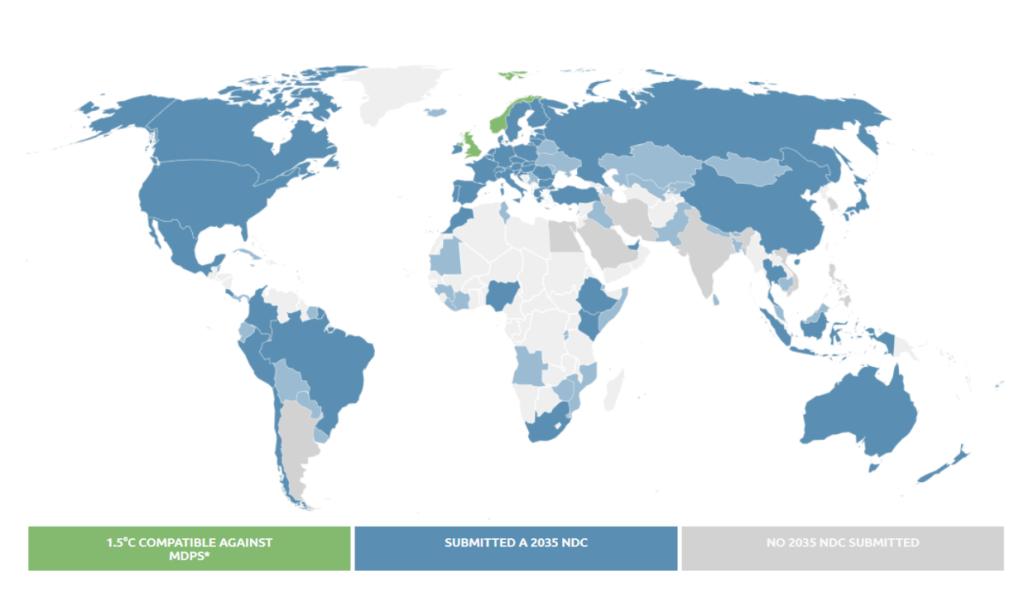
Nationally Determined Contributions (NDCs) published
All 194 countries signed up to the Paris Agreement need to submit an NDC every 5 years, setting out how they intend to reduce emissions.
By the end of COP30, 119 countries representing 74% of global emissions had submitted new national commitments in NDCs. While these commitments show some progress, UN analysis finds that with the latest NDCs and current policies, the world remains on course for 2.3-2.5oC of warming, which would cause severe and widespread climate impacts across the world.
Map of submitted NDCs
Action Agenda
For the first time, the voluntary climate action from civil society, businesses, investors, cities, states, and countries has been brought together under one banner, called the ‘Action Agenda’. It engages actors who do not negotiate COP agreements yet are essential for turning pledges into reality.
The Action Agenda has six main themes, including Energy, Biodiversity, Food Systems, Cities, Human Development, and other enablers. It has already consolidated more than 480 initiatives into 117 concrete “Plans to Accelerate Solutions”, and mobilised capital in the billions.
Protests, humidity, and a fire
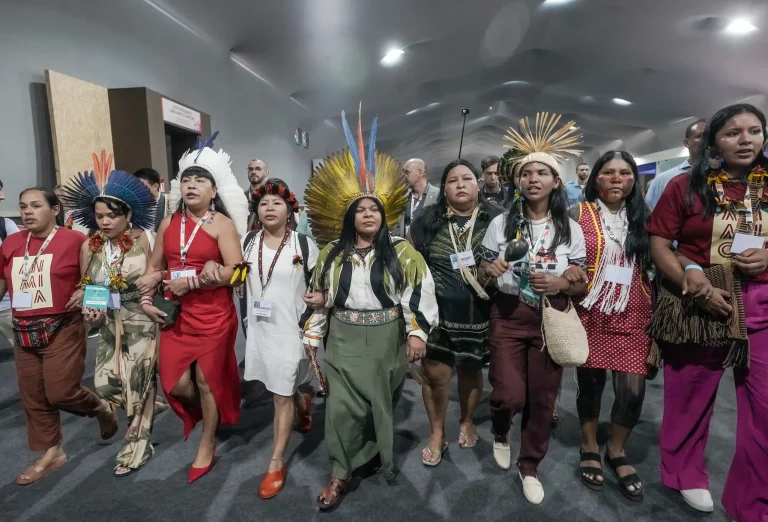
The event attracted protests about deforestation, Indigenous rights, youth rights, and environmental justice. At one point, Indigenous protesters blocked the COP30 entrance, demanding action from the Brazilian Government. Further from the venue, activists took to the streets of Belém, urging negotiators to ramp up ambition, and highlighting that those who are least responsible for climate change are the most affected by it.
The heat and humidity at COP was a reminder of the daily lives of millions of people across the world, who live with extreme temperatures every day, often without the ability to escape the heat and cool themselves.
A fire broke out in in the Blue Zone, the official conference area of COP. Thousands of conference goers were evacuated, and the negotiations were temporarily paused. There were no serious injuries. Some noted the symbolism of a burning planet at the climate talks.
Calls for a reform of the COP process
COP30 featured the strongest political push in years to reform how they work, including their size, structure, governance, mandates, and the overall effectiveness of the UN climate regime. Many noted that the consensus-based approach for all 194 countries means that certain petrostates can block or obstruct action, which is a real problem. One solution could be to shift to a majority vote model, but this itself would need consensus from the countries. In addition, some suggest that the system needs smaller, more focused negotiation groups rather than one annual conference.
A long way to go still
COPs provide direction, send signals, and help steer the direction. There is no doubt that this year’s COP was a mixed bag, and the macroeconomic and geopolitical backdrop presents a challenge to the implementation of net zero.
Emissions in 2030 need to fall 25% from 2019 levels for a 2oC pathway, and 40% for a 1.5oC pathway. Last year they rose by 2.3%. Much more action is needed on all fronts to bring down emissions rapidly. That includes consistent and strong policy signals,funding and investment from public and private sectors, alongside the mainstreaming of just transition principles and adaptation and resilience considerations.
Climate resilient development creates growth, mitigates risks, and reduces costs to the global economy in the long term, when done right. As we look ahead to COP31 in Turkey, it’s essential that we continue to accelerate progress to a safer and prosperous future for all.